

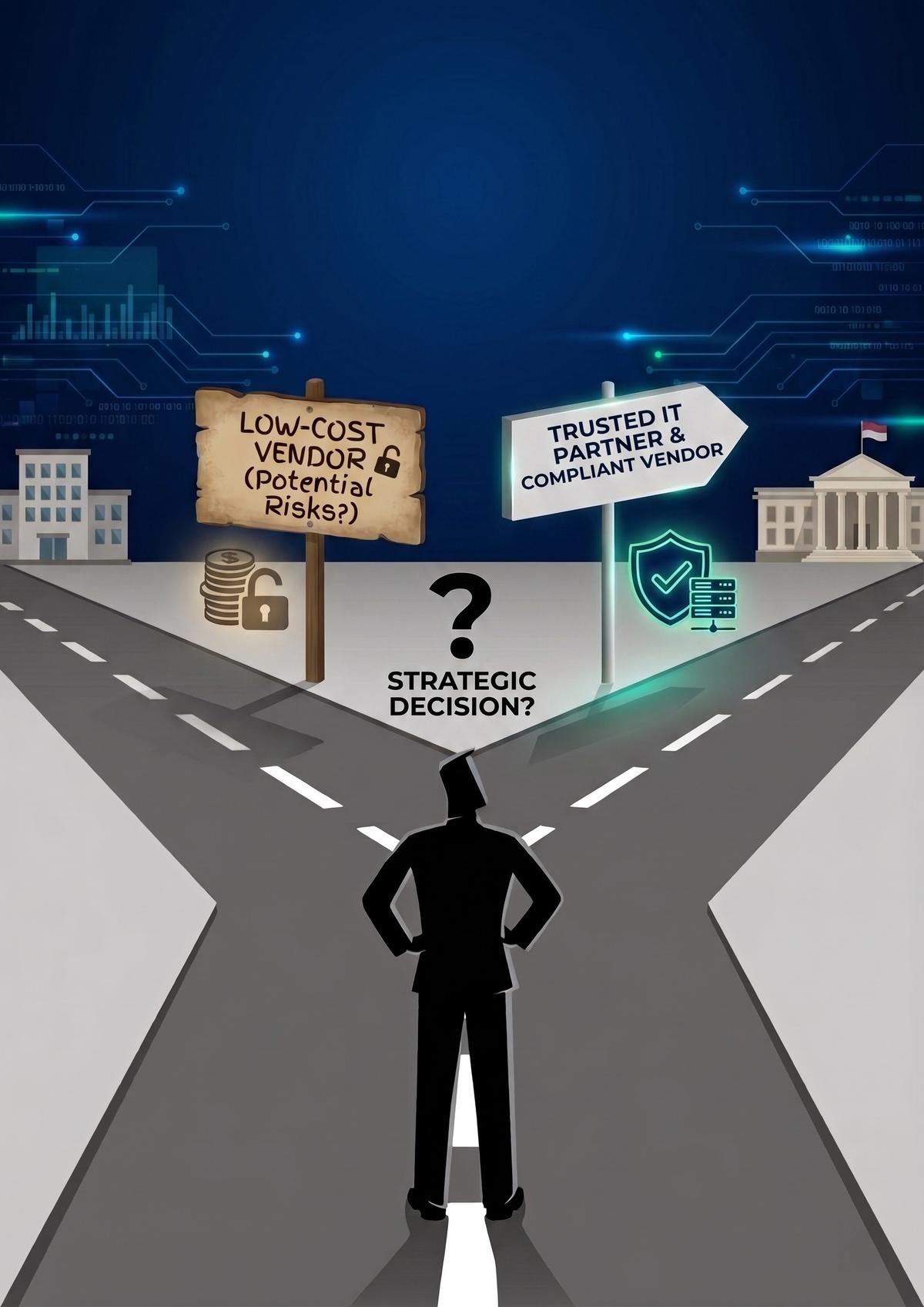
The wave of digital-based government transformation (e-Government) forces every public service institution to be agile — from institutional profile websites and integrated electronic licensing services to Smart City programs. Unfortunately, the biggest challenge for institutional leaders today is: finding an IT vendor that is truly competent in the bureaucratic climate, not just an ordinary software house.
Building a government technology ecosystem carries a far heavier regulatory burden than commercial projects. Here are the metrics that must be audited before signing any SPK (Work Order):
1. Legal Standing and Presence in the LKPP E-Catalog
This is the most objective selection instrument. Vendors targeting the government sector must comply with the latest Presidential Regulation on procurement by listing their services in the LKPP E-Catalog portal. Selecting a vendor ready for the e-Purchasing pathway saves the Commitment-Making Officer (PPK) from the complexity of conventional tendering/bidding, while reducing the risk of state financial losses or BPK findings upfront.
2. BSSN Security Standards & Kominfo PSE Registration Compliance
Vendors must do more than "make it work." Public-facing applications hold sensitive information related to population data and state revenues. Vendor-built systems must undergo Penetration Testing simulations to prove that no backdoors have been injected via third-party libraries. Vendor involvement is also needed for PSE (Electronic System Organizer) registration to comply with Kominfo's legal framework.
3. Service Level Agreement (SLA) & Post-Sale Support
A classic ailment many small institutions suffer from is the "buy and forget" syndrome — the vendor disappears in year two without leaving clear technical documentation. Demand SLA clauses that guarantee bug fixes within 2×24 hours of a complaint ticket being opened. Remember: a government server going down can easily become national news that damages the accountability of a regent or department head.
4. Code Scalability & Microservices Architecture
In government, ministry/department restructuring can occur after elections, and tax regulations routinely change whenever new government regulations are issued. Applications built on old monolithic assemblies will become headaches for structural IT teams in the future. You need a microservices architecture with an API Gateway where payment features, citizen databases, and complaint features run on separate but seamlessly synchronized cloud pipelines.
Whatever your modernization target, PT Meta Media Optima is ready to facilitate Government Solutions in full compliance with national regulations. Contact our B2G consultation specialists to align your APBD RUP with high-quality IT solutions.